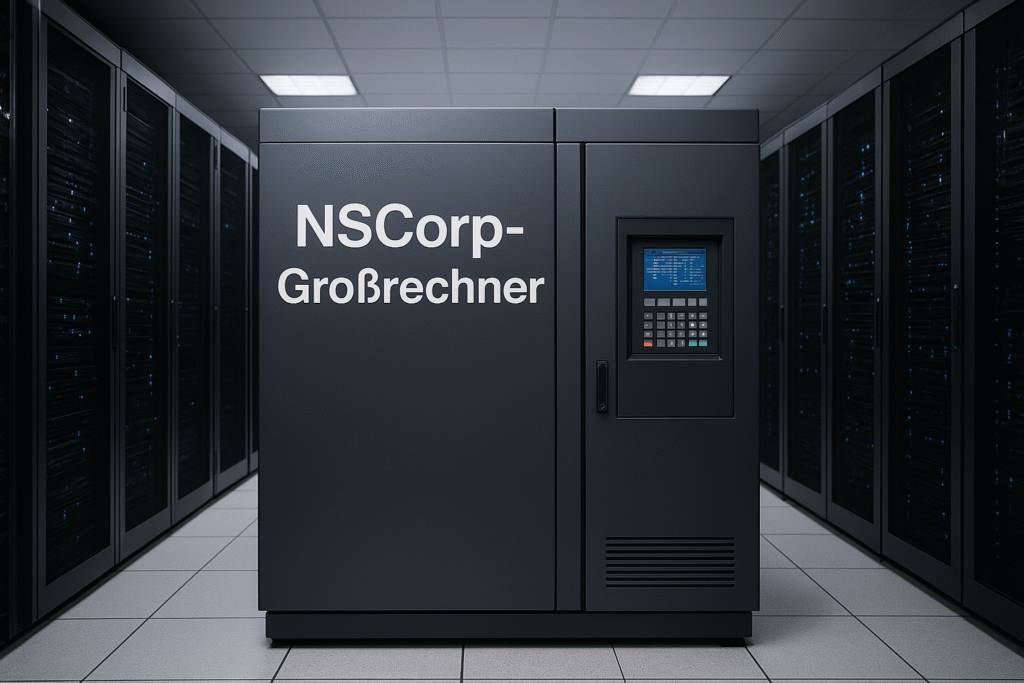

When people talk about high-performance computing, they usually think about rows of servers humming in a cold data center or massive cloud infrastructures run by tech giants. But the story behind a mainframe, especially one like the NSCorp-Großrechner, is far more interesting than a simple image of blinking hardware. It represents decades of engineering, strategic vision, and commitment to stability. In this article, we’re going to explore what makes the NSCorp-Großrechner special, why enterprises rely on it, and how it maintains relevance in a world dominated by cloud buzzwords and distributed architectures.
Even if you’re not a hardcore tech enthusiast, don’t worry—this article will walk you through everything in a friendly but expert-level way. Think of it like getting the inside scoop from someone who has been around big iron systems for years and knows how to explain them without drowning you in jargon.
1. What Exactly Is the NSCorp-Großrechner?
The NSCorp-Großrechner is a high-performance mainframe system designed for organizations that need serious reliability, robust data processing, and near-flawless uptime. While most people picture mainframes as old, outdated machines from the 1970s, the NSCorp system proves that modern mainframes are alive, evolving, and in many cases, outperforming distributed cloud systems in specific tasks.
To understand this better, imagine a system built not for hobby projects or experimental prototypes but for banks, governments, insurance providers, and institutions that cannot afford even a few minutes of downtime. The NSCorp-Großrechner is engineered with that level of responsibility in mind. Its architecture isn’t just powerful—it’s resilient, secure, and optimized for workloads that would overwhelm standard servers.
Another thing that makes the NSCorp-Großrechner stand out is the philosophy behind its design. It is not a machine you buy just to store files or run small internal tools. It’s built for mission-critical computations: large-scale transactions, complex simulations, resource management systems, and real-time analytics. This focus is why the Großrechner remains at the heart of enterprise computing even in 2025.
2. The History and Evolution Behind NSCorp’s Großrechner Technology
To appreciate what the NSCorp-Großrechner can do today, it helps to look at how it got here. NSCorp, traditionally known for its enterprise hardware and software solutions, didn’t enter the mainframe world overnight. The company spent decades researching scalable architectures and experimenting with high-throughput processing before bringing its flagship Großrechner system to life.
In the early days, NSCorp focused more on distributed systems and custom server clusters. However, their engineering teams discovered major limitations when organizations attempted to scale these clusters to handle millions of transactions per second. That discovery pushed NSCorp toward building something with more consistency, less fragmentation, and deeper hardware-software integration—elements central to modern mainframes.
Over time, NSCorp refined its strategy and leaned into the idea of creating a system that unified the stability of traditional mainframes with the flexibility of modern enterprise computing. By combining support for legacy applications with frameworks for emerging technologies like AI and real-time analytics, NSCorp transformed the Großrechner into an infrastructural powerhouse that continues to evolve.
3. Architecture of the NSCorp-Großrechner: A Deep Dive
If there is one thing tech experts love about the NSCorp-Großrechner, it’s the architecture. While the exact blueprint is proprietary, the general principles behind its structure are public enough to understand how it achieves such high levels of performance.
The core architecture relies on a combination of multi-channel parallel processors, dedicated co-processors for specialized tasks, and an ultra-optimized scheduling system. This design allows the system to process thousands of concurrent operations with minimal latency. Unlike typical server environments where workloads bounce between nodes, the Großrechner centralizes compute power in a way that reduces bottlenecks dramatically.
Another key component is memory management. The NSCorp-Großrechner uses a hierarchical memory architecture that ensures frequently accessed data stays extremely close to the processors. This dramatically speeds up real-time processing. It’s like having a personal assistant who always has the exact information you need ready in hand, instead of having to dig through a filing cabinet every time.
Finally, communication within the Großrechner is designed to avoid the pitfalls commonly seen in distributed systems. Instead of relying constantly on network calls, internal modules communicate using a high-bandwidth interconnect fabric. The result is consistent performance, predictable behavior, and an environment where mission-critical workloads run without hiccups.
4. Performance Capabilities: Why the NSCorp-Großrechner Stands Out
Talking about performance isn’t just a numbers game; it’s about real outcomes. Organizations choose the NSCorp-Großrechner because it provides raw computing power with unmatched reliability. But there’s more to it than speed.
One of the major strengths of the NSCorp system is its ability to scale vertically. While cloud environments scale horizontally by adding more machines, mainframes like the Großrechner improve by enhancing internal components and optimizing workloads. This vertical scaling not only reduces complexity but also ensures that performance remains consistent even under extreme load.
Another performance factor is transaction throughput. Banks, for example, use systems like the Großrechner to handle millions of secure transactions every second. They rely on predictable processing, fast encryption handling, and atomic execution of operations. The Großrechner excels in all these categories, making it a preferred infrastructure backbone for industries where mistakes are costly.
A third performance advantage lies in workload consolidation. Instead of spreading tasks across dozens of servers, organizations can centralize operations on the Großrechner. This not only reduces overhead but also simplifies maintenance, improves efficiency, and cuts down energy consumption significantly—something NSCorp always highlights when discussing their system’s environmental impact.
5. Enterprise Use Cases: Where the NSCorp-Großrechner Really Shines
Mainframes often get labeled as “banking machines,” but the NSCorp-Großrechner proves that this category of technology is far more versatile. It supports a broad range of industries, each with unique demands that the system can handle gracefully.
The financial sector is an obvious example. Banks need lightning-fast transaction processing, fraud detection, and high availability. The Großrechner’s security features and processing consistency make it ideal for this environment. When millions of users rely on stable digital banking, there’s no room for slowdowns.
Government institutions also rely heavily on mainframes. Large-scale record systems, background verification processes, census data, and public administration tools require secure, long-term storage and reliable access. The NSCorp-Großrechner’s ability to run legacy software while supporting modern applications makes it perfect for government modernization projects.
Meanwhile, industries like healthcare, logistics, and manufacturing benefit from its predictive analytics and resource planning features. When you’re dealing with supply chain dependencies, patient records, or factory operations, you want a system that can track, process, and analyze data with near-zero downtime. That’s exactly where the NSCorp-Großrechner adds value.
6. Security Features Built Into NSCorp’s Mainframe Technologies
Security isn’t just a feature of the NSCorp-Großrechner—it’s one of its foundations. Every layer of the system is designed with protective mechanisms built directly into the architecture, not just added on as software packages.
One major strength is hardware-level encryption acceleration. Instead of relying entirely on software encryption, the Großrechner integrates cryptographic functions into the hardware itself. This makes data protection faster and more consistent without compromising performance. It also prevents a wide range of attacks that target software vulnerabilities.
Another essential security characteristic is compartmentalization. In the NSCorp-Großrechner, workloads are isolated not just logically but sometimes physically at the processor and memory level. If an application fails or is compromised, it doesn’t affect the rest of the system. This approach prevents chain-reaction failures, something that can happen in conventional servers.
Finally, NSCorp emphasizes auditability. Every operation performed on the mainframe can be logged, monitored, and analyzed. This is extremely important for companies that must comply with strict regulations. Having a transparent system that records system-level interactions helps organizations maintain trust and legal compliance.
7. NSCorp-Großrechner vs. Cloud Computing: Are Mainframes Still Relevant?
With cloud computing dominating tech discussions, it’s fair to ask: where does a mainframe like the NSCorp-Großrechner fit?
The simple answer is that mainframes and cloud systems are not enemies—they’re complements. Cloud excels at flexible deployment, scaling for unpredictable workloads, and enabling distributed collaboration. Mainframes excel at handling consistent, high-volume mission-critical workloads.
One thing the Großrechner does better than cloud environments is predictable performance. Clouds sometimes suffer from “noisy neighbor” problems or unpredictable scaling delays. Mainframes avoid this entirely. When an enterprise needs guaranteed throughput, the Großrechner delivers.
Another area where the Großrechner wins is long-term cost efficiency. Cloud services can become extremely expensive when dealing with huge transaction volumes. A mainframe centralizes these workloads, reducing operational costs over time. This financial efficiency is one reason mainframes remain popular with large organizations.
In reality, most modern enterprises use a hybrid approach. They combine cloud services for flexibility and mainframes like the NSCorp-Großrechner for mission-critical stability. This synergy helps organizations get the best of both worlds.
8. Future Outlook: Where NSCorp Plans to Take the Großrechner Next
The future of mainframes is often misunderstood. People assume older technologies fade away, but mainframes repeatedly prove their long-term value. NSCorp is fully aware of this and continues to invest heavily in next-generation upgrades.
One major focus area is AI integration. NSCorp is working on enhanced machine learning accelerators built directly into future Großrechner generations. This will help enterprises run complex analytics without sending data to external cloud services, improving both security and efficiency.
Another direction is sustainability. The next versions of the NSCorp-Großrechner may include more eco-friendly cooling mechanisms, lower power consumption, and optimized hardware utilization. As more companies commit to carbon-neutral operations, sustainable mainframes will play a major role.
Finally, NSCorp plans to expand cross-compatibility and multi-language development support. This means future Großrechner models will allow developers to use mainstream programming tools more easily, bridging the gap between traditional mainframe operations and modern development practices.
Conclusion
The NSCorp-Großrechner is much more than a piece of enterprise hardware—it’s the backbone of modern, reliable, mission-critical computing. In a world dominated by cloud buzzwords, the Großrechner quietly remains the dependable engine that keeps banks running, governments operating, and industries connected.
Whether it’s ultra-high processing speeds, rock-solid security, or long-term sustainability, NSCorp’s mainframe technology shows that sometimes the strongest solutions are the ones built on decades of focused engineering. The future isn’t about choosing between cloud and mainframes—it’s about using them together to build systems that are powerful, stable, and ready for whatever tomorrow brings.